Tight Muscles Don’t Equal Strong.
And “Droopy” Skin Isn’t Always About Fat.
Why An Overactive Sympathetic System Can Create Tight Muscles &“Droopy” Skin. The Connections Most People Miss. Drop The Shoulders. Take A Deep Breath. Read Below.
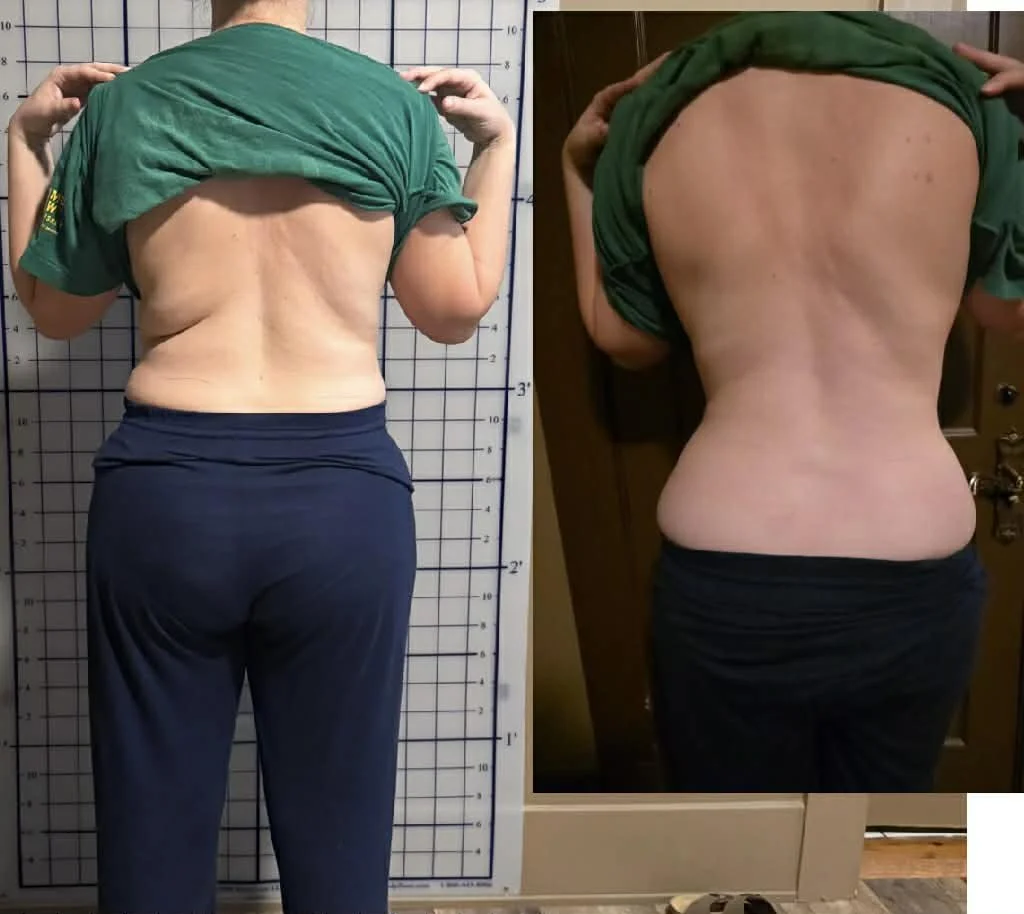
(Photo above: Left = Before | Right = After) | Same client on the same day 90 minutes apart. Left in clinical suite. Right in relaxation suite.
When people see a before-and-after like this, they often assume:
Weight loss.
Fat reduction.
“Getting toned.”
None of that happened.
No dieting.
No cosmetic procedure.
No extreme exercise.
MASSAGE THERAPY ONLY
What changed was fascial tension, connective tissue health and stabilizer activation.
And that, my dear reader, changes shape!
Your Skin Reflects Your Fascia And Your Nervous System
Skin doesn’t just sag.
It responds to what’s happening underneath it. It shows what is happening in your fascia, connective tissue, nervous system and deep stabilizing muscles.
Fascia is the body-wide web of connective tissue that:
• suspends muscles
• distributes tension
• helps create internal lift
• transfers force efficiently
• supports posture
When fascia becomes restricted, densified or dehydrated (which can happen from stress, injury, inflammation, surgery or chronic compensation patterns), it loses elasticity.
When that elasticity decreases, you may notice:
• softened flanks
• lower back “spilling” over waistbands
• tissue that looks looser even without adipose tissue gain
• skin that appears less supported
This is not a cosmetic problem.
It is a connective tissue and neuromuscular problem.
Tight Does Not Mean Strong
Many of the muscles that feel tight are actually overworking because deeper stabilizers aren’t doing their job.
When deep core stabilizers, gluteal stabilizers, or spinal stabilizers don’t activate properly, the body recruits larger surface muscles to hold everything together.
Those surface muscles become:
• tight
• guarded
• fatigued
• wrapped in dense fascia
Stretching them repeatedly without restoring stabilizer function can increase laxity without restoring tone.
That’s why some people say:
“I stretch constantly but I still feel tight.”
“I feel softer even though I’m active.”
Because length without proper activation creates collapse.
Fight-or-Flight Changes Tissue Tone
When the sympathetic nervous system (fight-or-flight mode) stays elevated for long periods due to stress, pain, trauma, inflammation or even just constant “go mode” the body shifts into protective patterns.
That looks like:
• chronic muscle guarding
• reduced tissue hydration
• increased fascial density
• decreased circulation to superficial layers
• reduced diaphragmatic breathing
• stabilizers shutting down while global muscles grip
This state is designed for survival not longevity.
When you live in sympathetic dominance:
The body prioritizes bracing over elasticity.
Stability through gripping.
Protection over lift.
Over time, this creates:
• tight but weak muscles
• restricted fascial glide
• tissue that feels firm but unsupported
• skin that appears less lifted
Not because you gained fat.
But because your system is holding tension.
Where Breath Work Changes Things
There was another key piece in this process:
Restoring diaphragmatic movement.
When someone lives in chronic sympathetic (fight-or-flight) activation, the diaphragm often becomes restricted. Instead of moving three-dimensionally with each breath, it becomes shallow, guarded and vertical.
When the diaphragm is restricted:
• intra-abdominal pressure becomes dysregulated
• the deep core system (transversus abdominis, pelvic floor, multifidus) cannot coordinate properly
• stabilizers underperform
• surface muscles compensate
• fascial tension increases
The diaphragm is not just a breathing muscle. It is a major regulator of the autonomic nervous system and functionally married to most things in the body.
When we worked on restoring fascial glide around the ribcage, thoracolumbar junction and abdominal wall we incorporated intentional breath work several things shifted:
• the nervous system began moving out of fight-or-flight
• intra-abdominal pressure normalized
• deep stabilizers had the ability to be re-engaged
• global gripping patterns decreased
• connective tissue hydration improved
Once the diaphragm regained full excursion, the entire pressure system of the body reorganized.
It’s restored pressure management.
It’s a diaphragm that can descend fully.
A ribcage that can expand.
A pelvic floor that can respond.
A core that can stabilize without bracing.
Breath is often the missing link between fascial restriction and visible change.
When the diaphragm is free, the body doesn’t have to hold itself up with tension.
And that changes everything.
What Changed In The “After”
The image on the right reflects:
• improved fascial glide
• a down regulated sympathetic system
• reduced tissue guarding
• restored tonicity within connective tissue
• better neuromuscular coordination
• improved deep stabilizer engagement
This was achieved through hands-on fascial therapy in Lafayette, focused neuromyofascial treatment and strategic use of Frequency Specific Microcurrent (FSM).
How Frequency Specific Microcurrent Supports This Process
As the only massage therapist in Louisiana offering Frequency Specific Microcurrent integrated into hands-on sessions, I use FSM to support:
• connective tissue repair
• inflammation modulation
• scar tissue softening
• nervous system regulation
• fascial hydration
• down regulating the sympathetic system
FSM works by delivering low-level electrical currents at specific frequencies designed to support tissue healing and reduce inflammatory patterns within connective tissue.
When fascia is less inflamed and more hydrated, it regains elasticity.
When the nervous system feels safe, guarding decreases.
When guarding decreases, stabilizers can activate properly.
And when stabilizers activate properly, the body regains internal lift.
The result?
The outside reorganizes.
This Is Functional Restoration Not Body Sculpting
I do not perform cosmetic sculpting.
I do not promise weight loss.
I do not “tighten” skin.
What I do is help restore:
• connective tissue health
• neuromuscular balance
• proper load distribution
• functional posture
• nervous system regulation
And when those systems work the way they were designed to, the body often changes shape naturally.
Clients frequently say:
“My clothes fit differently.”
“I feel more supported.”
“I didn’t lose weight but I look different.”
That’s not aesthetic manipulation.
That’s physiology doing what it’s supposed to do.
Why This Matters For Chronic Pain & Instability
When fascia is restricted and stabilizers are underactive, it doesn’t just change appearance.
It contributes to:
• chronic low back tension
• hip instability
• SI joint discomfort
• shoulder compensation
• movement inefficiency
Addressing connective tissue dysfunction at its root improves both:
Function
And form
If You’re Searching For:
• Fascial therapy in Lafayette
• Connective tissue therapy near me
• Frequency Specific Microcurrent in Louisiana
• Neuromyofascial therapy Lafayette
• Help for chronic tight muscles that won’t stretch
This is exactly the type of work we focus on.
A Gentle Disclaimer
This image reflects one individual’s response to therapeutic sypmathic nervous system down regulation, connective tissue work and neuromuscular restoration. Results vary based on health history, inflammation levels, stress patterns, movement habits and overall lifestyle.